
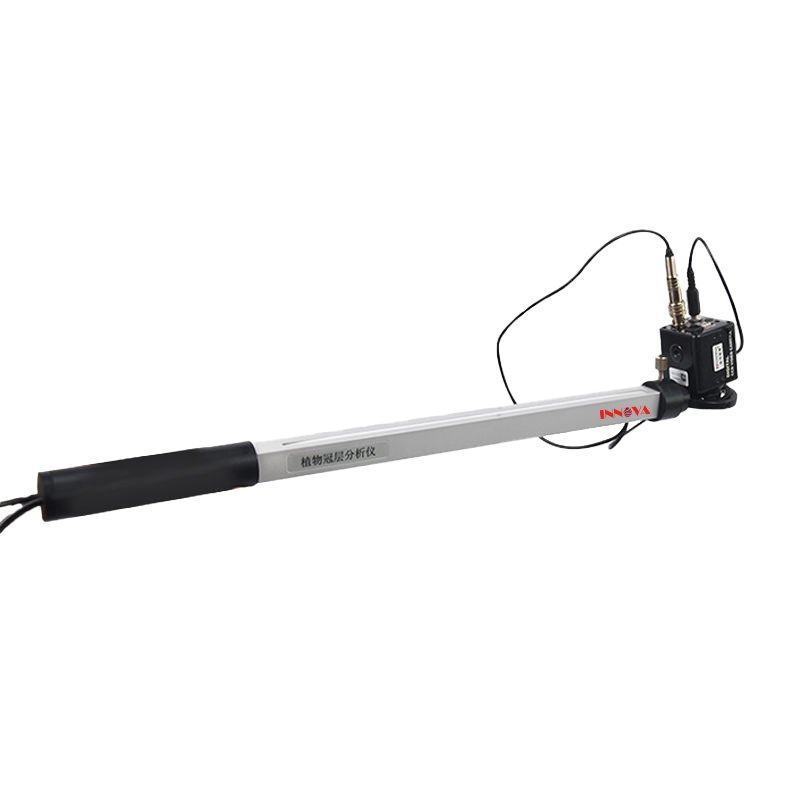
Plant Canopy Analyzerr is used for research on plant canopies of various heights. It utilizes a fisheye lens and a CCD image sensor to capture images of plant canopies, and through specialized analysis software, it obtains relevant indicators and parameters related to plant canopies. Using a fisheye lens for imaging to measure plant canopy data requires only a single operation, simplifying the cumbersome process of traditional measurement methods that require multiple measurements at fixed points over the course of a day. Additionally, using the imaging method to measure the canopy allows for active avoidance of canopy gaps that do not meet the criteria for calculating canopy structural parameters, as well as obstacles that do not meet the criteria for measurement calculations.
1. The fisheye lens automatically maintains a horizontal position: A compact fisheye camera lens, specifically designed for measuring plant canopy structures, is mounted on a handheld gimbal stabilizer, automatically maintaining the lens in a horizontal position without the need for a tripod;
2. The fisheye lens can be extended into the canopy: The lens is mounted at one end of the boom arm. Due to its compact size and measurement rod, it can be conveniently extended horizontally forward or vertically upward to different heights within the canopy, enabling rapid layered measurements to determine the vertical distribution of light transmittance and leaf area index within the canopy;
3. Image analysis software: The image analysis software allows arbitrary definition of image analysis regions (10 zones for zenith angle and 10 zones for azimuth angle).
4. Ability to exclude unreasonable canopy sections: When conducting regional analysis of canopies in different directions, users can arbitrarily exclude ground features and unreasonable canopy sections (such as missing plants or edge row issues). By selecting different zenith angle start and end angles, users can avoid canopy pore conditions that do not meet the criteria for calculating canopy structural parameters. Through manual adjustment of thresholds, users can more accurately measure parameters such as leaf area index.
| Model | INOPC-6 | INOPC-10 |
| Testing items | Leaf area index Average leaf inclination angle Sky scattered light transmittance Direct radiation transmittance through plant canopy at different solar zenith angles Extinction coefficient of canopy at different solar zenith angles Azimuthal distribution of leaf area density |
Leaf area index Average leaf inclination angle Aggregation index 1 Aggregation index 2 Canopy openness Sky scattered light transmittance Direct radiation transmittance (gap ratio, transmittance) of plant canopy at different solar zenith angles Extinction coefficient of canopy at different solar zenith angles Azimuthal distribution of leaf area density (opacity) Photosynthetically active radiation (PAR) |
| Field of view | 150° | 180° |
| Resolution | 768×494 | 2592 × 1944 |
| Measurement range | Zenith angle from 0° to 75° (150° fisheye lens) can be divided into ten regions; azimuth angle of 360° can also be divided into ten regions | Zenith angle from 0° to 90° (180° fisheye lens) can be divided into ten regions, and the azimuth angle of 360° can also be divided into ten regions |
| PAR sensing range | Sensing spectrum 400 nm to 700 nm | |
| Measurement range | 0 to 2000 μmol/m²·s | 0~3000μmol/㎡•S |
| Analysis software | Plant canopy analysis system | |
| Power supply | 8.4V rechargeable lithium-ion battery pack | |
| Probe dimensions | Diameter 6 cm, height 10 cm | |
| Total weight | 500 g (excluding laptop computer) | |
| Transmission interface | USB port, Ethernet port | |
| Operating temperature | 0°C to 55°C | |